The BMWs project (started in january 2021) is over
BMWs (ANR-20-CE45-0018) was funded by ANR (Agence Nationale de la Recherche).
BMWs is about spacetime localization of brain activity.
The EEG (electro-encephalography) and MEG (magneto-encephalography) source localization problems are strongly ill-conditioned. Current approaches suffer from severe limitations, among which a poor spatial resolution, the absence of modeling of temporal dynamics, and the difficulty to fuse modalities.
The main objective of BMWs is to develop and combine for the first time several state-of-the art techniques to estimate the fine spatio-temporal dynamics of brain networks with unprecedented precision and with quantification of uncertainties
BMWs will also implement the developed approach within MNE-Python, a common, open source, software platform.
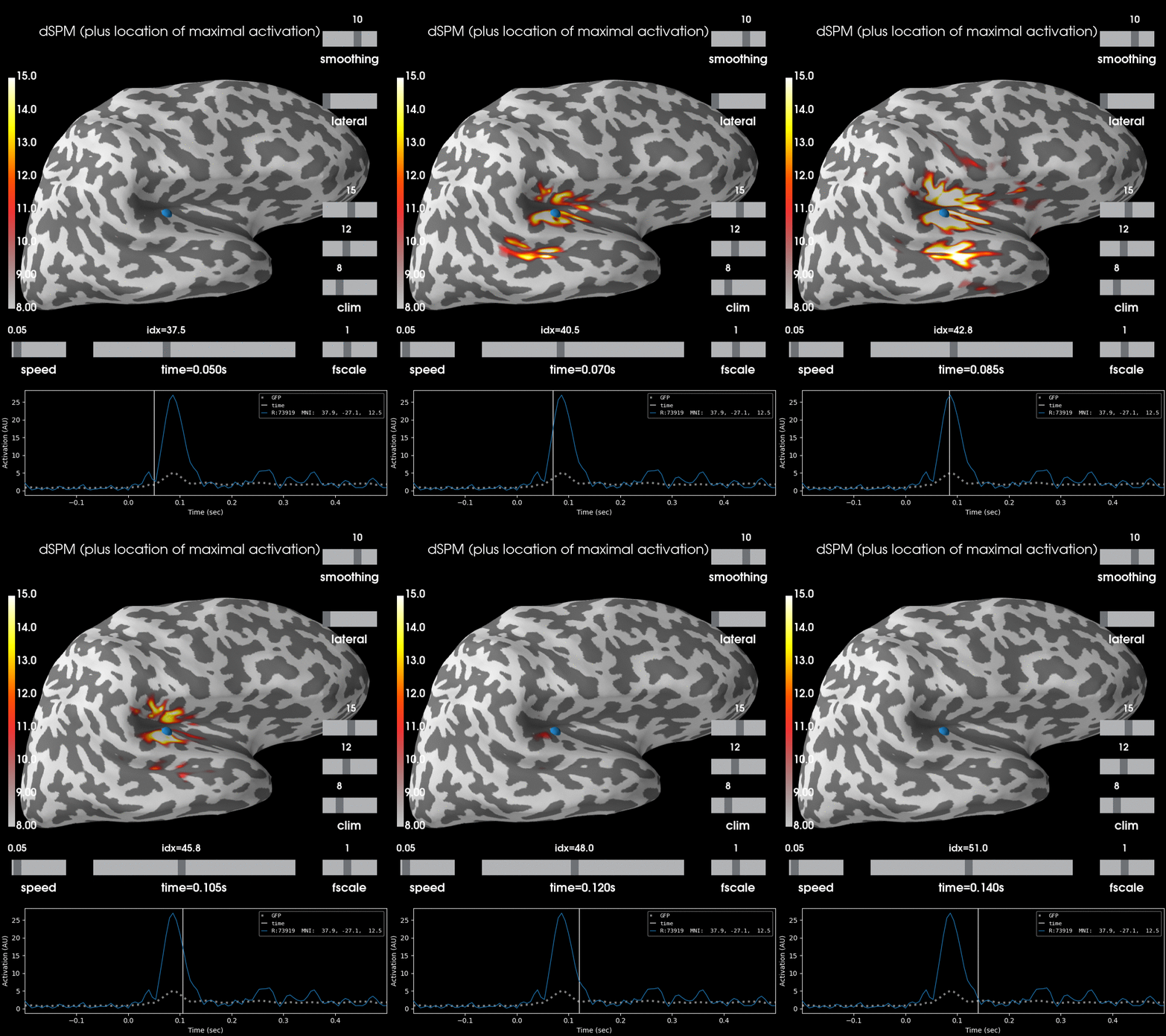
Wavelets on the cortex surface.
Due to the strong ill conditioning of the M/EEG inverse problem, the spatial extent of cortical sources is overestimated by most approaches, while depth is underestimated.
Within BMWs, brain sources are expressed as sparse linear combinations of spatial wavelets defined on the cortical surface, using the spectral graph wavelets construction.
Left image: Coarse to fine wavelets located in the primary auditory cortex.
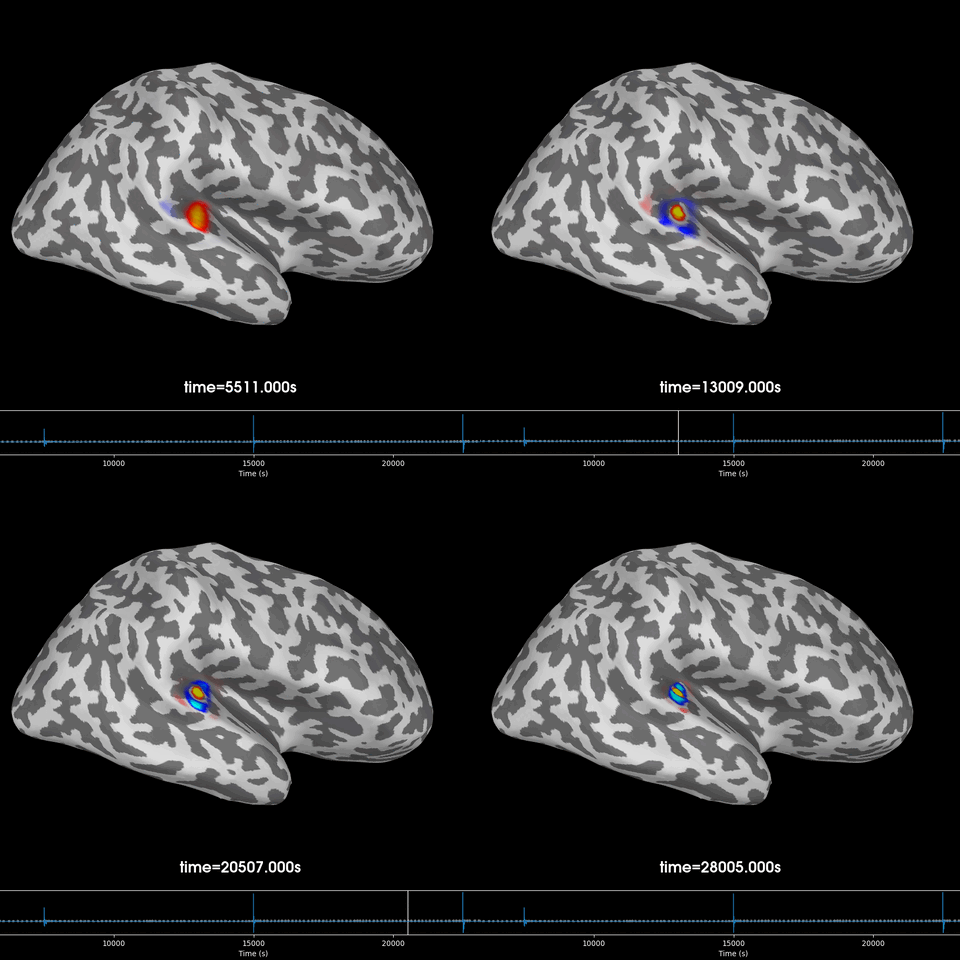
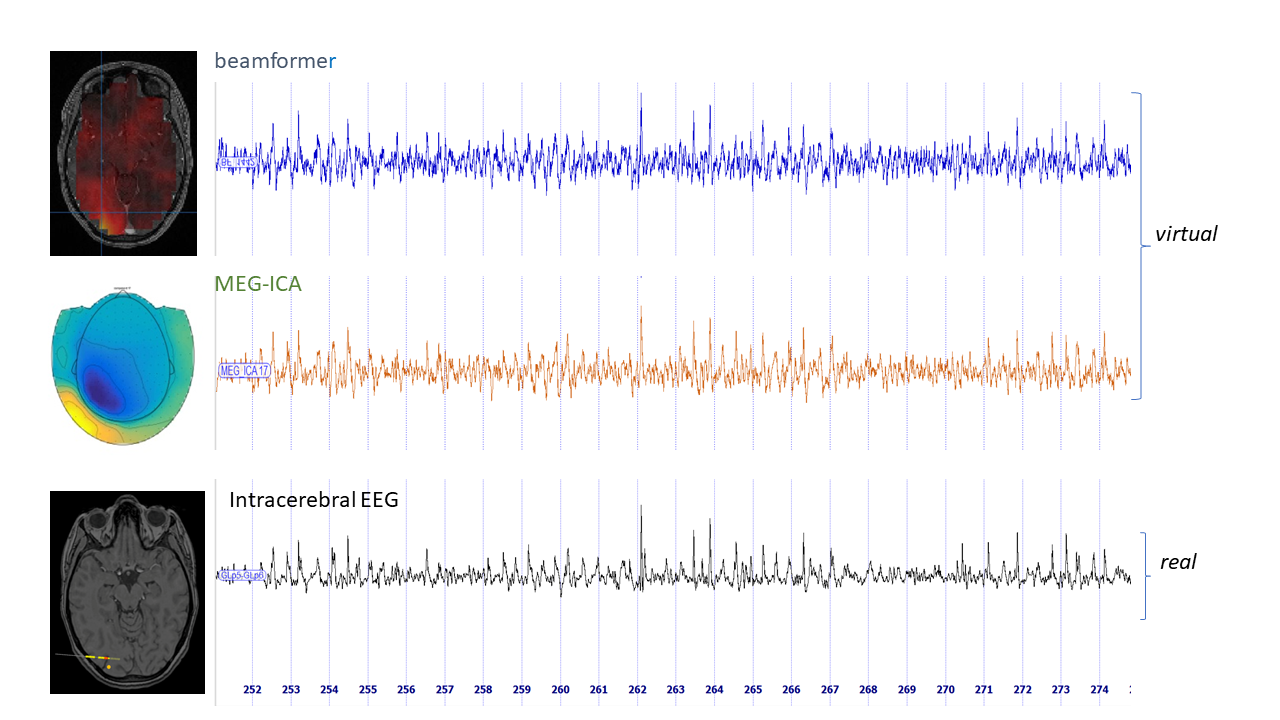
Joint MEG/SEEG recordings.
It has been shown recently by the Marseille team that it is possible to overcome technical challenges and record simultaneously EEG, MEG and intracerebral EEG, so-called stereotactic EEG (SEEG).
One of the main objectives of BMWs is to exploit intracerebral EEG data for validating inverse M/EEG solutions, and compare the approaches developed within the project and state of the art algorithms.
Directeurs de la rédaction : Christian Bénar et Matthieu Kowalski
Projet ANR-20-CE45-0018 BMWs
Last modified: June 10, 2025.